
Velenza BOC
You did the work. Get paid for it.
Every company does work it never bills, and bills work it cannot prove.
Detention the shipper agreed to by phone. Scope the client expanded in a meeting. A delivery the customer disputes. Money leaks where the proof and the invoice live apart. Velenza joins the dock time, the agreement, the rate confirmation and the bill into one chain, and raises what is earned and unbilled every day.
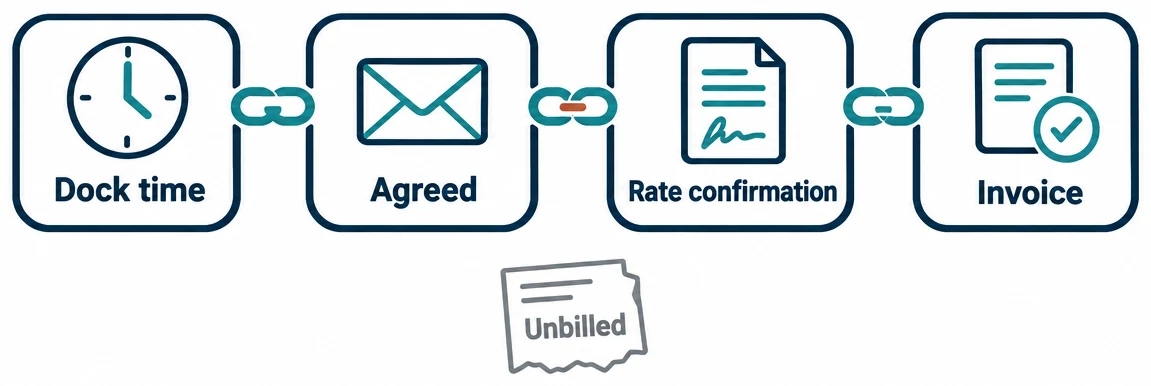


Every event becomes a lineThe dock timestamp, the extra hour, the added deliverable: each is linked to the order and to the contract clause that makes it billable.

Every invoice carries its proofThe email in which the customer agreed, the signed delivery and the rate confirmation travel with the line, so a dispute is answered, not written off.

Unbilled work surfaces dailyThe CFO and CRO seats read the record every day and raise what was earned and not yet billed before the month closes.
What the seams cost
The work was done. Half the detention is never paid, nearly one services dollar in twenty never arrives, and the dispute is lost because nobody can find the email.
of detention invoices are paid, although 94.5% of fleets charge detention.
of services revenue lost between earned and realized in 2025.
small-business invoices is more than 30 days late.
Intuit QuickBooks, 2025 Late Payments Report (2,487 US small businesses)
With Velenza the proof is attached before the invoice goes out.
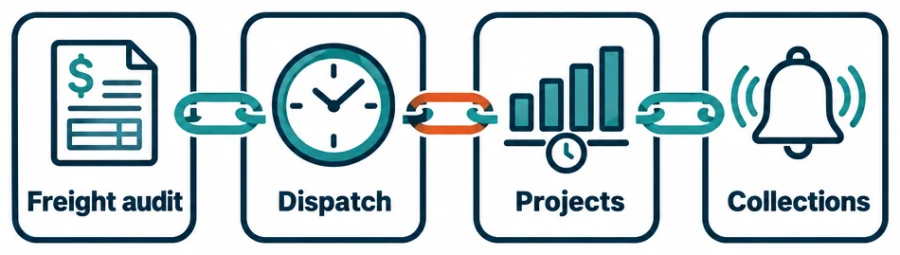
Where today’s tools stop
A freight audit firm sees the carrier invoice, not the email in which the shipper agreed to the charge. The dispatch system records the dock time, not the detention clause. The project system logs hours, not the meeting where the client expanded the scope. Collections software chases the invoice but cannot answer the dispute. Velenza holds all of it as one record.
The work is already done. Now the invoice can prove it.
Velenza BOC
How the seams close.
The shipper disputes $4,200 of detention on last month’s loads.
VelenzaFourteen stops over two hours, each with the truck’s electronic log time; the rate confirmation’s detention clause at $75 an hour after two hours; the shipper’s email of 3 March agreeing to it. You re-issue the invoice with the proof attached and credit the two stops that were under two hours.
The client says the extra dashboard was always in scope.
VelenzaStatus meeting of 12 June: the client asked for the dashboard and the project manager agreed to “add it as a change”. The project system shows 38 hours against it and no change order. The CRO seat raises the change order, transcript cited, for your approval.
Illustrative exchanges. The figures are examples.
In the room: CFO · Luca Pacioli, CRO · Zig Ziglar, COO · W. Edwards Deming
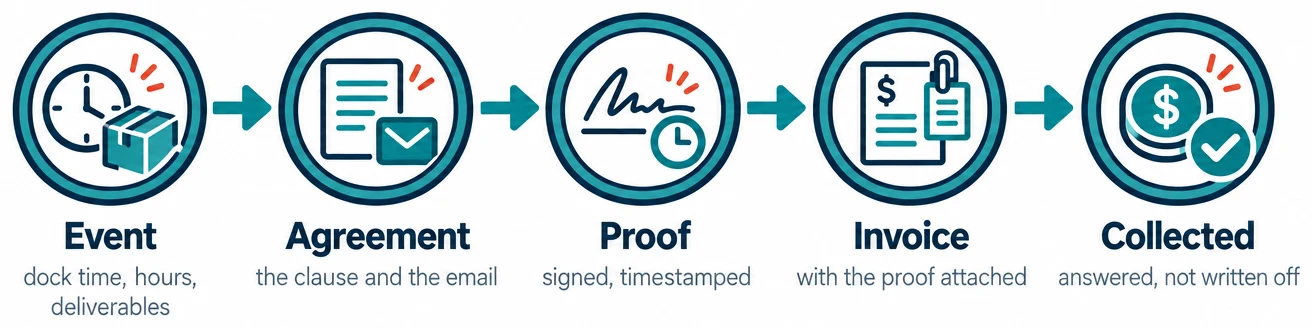

Earned, then billed
LogisticsDetention, layovers, lumper fees, redeliveries and the other extra charges are events on the record, each matched to the contract clause that makes it billable.
ServicesTime, expenses and scope changes are matched to the engagement letter and the change order, and what was worked against what was billed is read per project, not per quarter.
DisputesEvery disputed line carries its evidence, so a dispute is a conversation about the proof, not a write-off.
A year of seams, in dollars
LogisticsFifty tractors, each driver detained 150 hours a year, billed at $75 an hour and paid on half: about $281,000 a year billed and never collected. Collecting half of it is $140,000.
ServicesAt 4.5% leakage a $15M firm leaves $675,000 a year between earned and realized; the leaders run below 3%. Every point recovered is $150,000.
Worked examples on the industry figures above, with a $75 hourly detention rate and 150 detained hours a year assumed; your numbers will differ. Worked examples and industry figures, never a measured result; your figures come from your record.
Where else it applies
Construction (change orders), healthcare practices (unbilled procedures and denials), manufacturing (unbilled expedites and tooling), any business where the proof of work and the invoice live apart.
Where this case ends
This is revenue earned at the agreed price and not realized. Margin blind spots is the price being wrong in the first place. Promises that never reach the system is the agreement never being written down. A dollar leaks through only one of the three.

Take back control of your business
Velenza sits above your existing platforms and connects their records and conversations. Keep what works; choose native capabilities on your terms.
Brandon Meyer | Founder/CEO, Velenza BOC Inc
brandon@velenzaboc.com | www.velenzaboc.com