
Velenza BOC
Cash you can’t see.
Cash is the one number every owner watches and the one nobody can see.
The ledger knows what was invoiced. It does not know that the client said on Tuesday’s call they will not pay line 4, that the load was delivered short, or that the renewal slipped a quarter. So the forecast is a spreadsheet, and the company pays for its own money in factoring fees and missed discounts. Velenza projects cash from the ledger, the dispatch board, the pipeline and the conversations together.
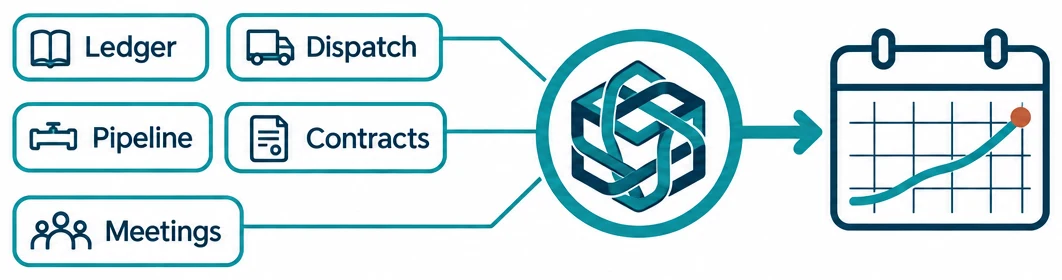


Receivables ranked by proofEvery open invoice carries what stands behind it: the signed delivery, the agreed scope, the dispute raised in a meeting. Collections start there.

Thursday, not month-endPayables are timed against discounts and cash on hand; a quick-pay or factoring decision is made on the real position.

Disputes with the evidence attachedA disputed line is a conversation about the proof, not a write-off, raised before it ages.
What not seeing it costs
Half of employer firms struggle with uneven cash flow, and the small businesses with the most late invoices run on credit cards.
of employer firms say uneven cash flow is a financial challenge.
Federal Reserve Banks, 2025 Report on Employer Firms (7,653 firms)
average owed to a small business on unpaid invoices; 56% are owed something.
Intuit QuickBooks, 2025 Late Payments Report (2,487 US small businesses)
of CFOs lack complete trust in the accuracy of their own financial data.
With Velenza the cash picture is read from every system, every day.
Where today’s tools stop
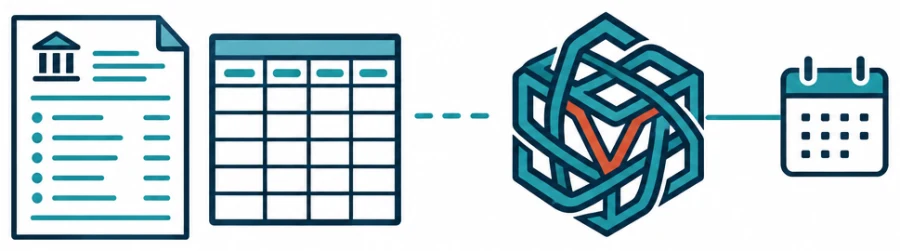
Cash-forecasting tools read the ledger and the bank. Collections software sends reminders. A factor buys the invoice. None of them knows the load was delivered short, the line was disputed in a meeting, or the approval holding a discount is on someone’s vacation. Velenza reads all of it as one record.
Stop paying for your own money.
Velenza BOC
How cash becomes visible.
What does Thursday look like?
Velenza$412,000 due in on the ledger; $290,000 likely: two invoices disputed in Tuesday’s notes, and the Harbor milestone invoice waiting on an acceptance email in someone’s inbox. Payables due $318,000, with $90,000 discounted 2% through Friday. Invoice Harbor today and take the discount, the CFO seat says.
Should we factor the Northwind receivables again this month?
VelenzaLast month’s factoring cost $6,100. Northwind’s last six invoices paid at day 38 against net 30, every one with proof of delivery attached. The CFO seat recommends direct collection with the evidence and no factoring on this account.
Illustrative exchanges. The figures are examples.
In the room: CFO · Luca Pacioli, CRO · Zig Ziglar, COO · W. Edwards Deming

One cash picture
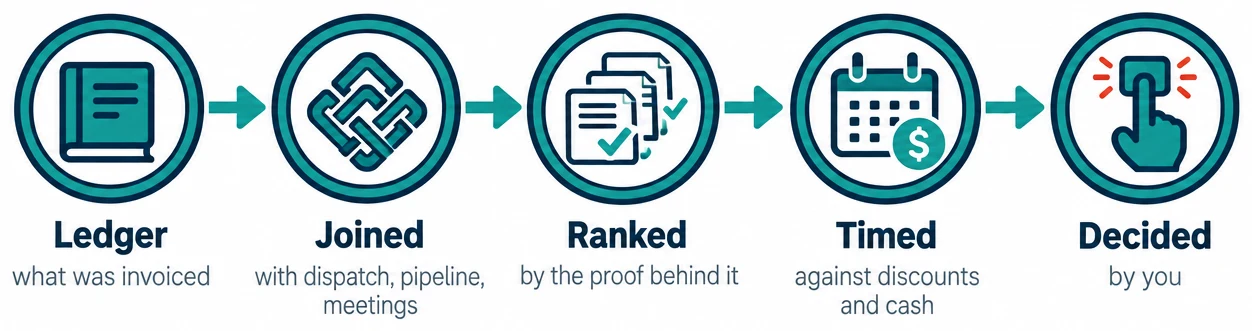
From every systemThe ledger and bank feeds, dispatch and delivery proof, the pipeline, payment terms, and the meetings where a payment was promised or disputed.
Read dailyThe CFO seat reads it each morning: receivables by the evidence behind them, payables against discounts and cash, quick-pay and factoring on the real position.
Terms are decisionsA profitable customer on net 60 and a factoring fee are the same dollar, and Velenza shows the cost of the terms you accept.
Waiting, in dollars
A week of collectionsOn $15M of services revenue a day of receivables is about $41,000 of cash; a week released once is about $290,000, worth about $29,000 a year at a 10% cost of money.
Fees avoidedA 50-tractor fleet factoring $12M of receivables at 2.5% pays about $300,000 a year; collecting half of it directly, proof attached, saves about $150,000.
Discounts captured2/10 net 30 is 36.7% a year; 2% on $10M of eligible payables is $200,000 a year.
Worked examples; the factoring rate is an industry range and the volumes are assumptions. Worked examples and industry figures, never a measured result; your figures come from your record.
Where else it applies
Every business that pays for its own money: construction (retainage), healthcare practices (payer delays), manufacturing (customer terms against supplier terms).
Where this case ends
This case is when the money arrives and what it costs to wait. Revenue leakage is whether the money was ever billed or defended; margin blind spots is whether the price was right.

Take back control of your business
Velenza sits above your existing platforms and connects their records and conversations. Keep what works; choose native capabilities on your terms.
Brandon Meyer | Founder/CEO, Velenza BOC Inc
brandon@velenzaboc.com | www.velenzaboc.com