
Velenza BOC
What was said is in the system.
The commitments that run a business are made out loud. Most never reach the system of record.
A surcharge agreed by phone. Scope expanded in a status meeting. A delivery window promised by email. The dispatcher, the project manager and the owner carry them in their heads; the dispatch board, the project system and the ledger never hear. Velenza Meeting puts every conversation in the company’s context, so a commitment made out loud is linked to the record it changes.



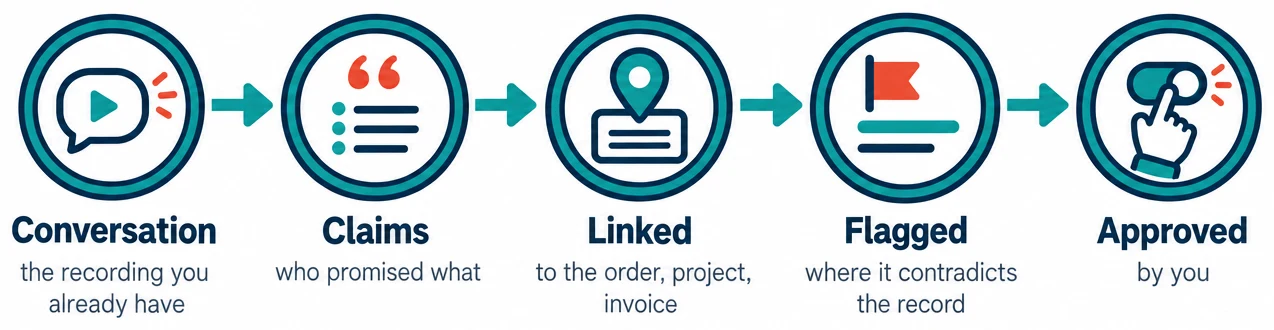
Said, then recordedAfter the call, Velenza reads the recording your meeting provider already made and ties every claim to the customer, load, project or invoice it is about.

Commitments become lines“We’ll add it as a change”, “detention after two hours”, “Friday by noon” become a change order, a rate clause and a delivery window, raised for your approval.

Memory that staysEach advisor keeps its own memory of your business, built from the conversations, so when the person who remembered leaves, the company still knows.
What forgetting costs
Half the room leaves without knowing who owns what. Scope grows, delivery slips, and the promise nobody wrote down is the one the customer remembers.
of meetings now span multiple time zones, up 35% since 2021.
of professional-services projects deliver late; overruns average 10.7%.
of workers frequently leave meetings without a clear idea of next steps or who owns which task.
With Velenza the meeting is part of the record, not a memory of one.

Where today’s tools stop
Meeting notetakers transcribe and summarize, then file the summary in a notes app or a chat thread. The dispatch board, the project system and the ledger never hear about it, and the email that changed the deal stays in one inbox. Velenza reads the conversation into the record.
Velenza analyzes the meeting. Your provider records it. You own the data.
Velenza BOC
How a conversation becomes a record.
Did the shipper agree to the surcharge?
VelenzaYes. Tuesday’s call at 14:10: the dispatcher’s “we’ll bill detention after two hours” and the shipper’s “fine”. The rate confirmation has no such clause. The CRO seat raises an amendment for signature, citing the recording at 14:12.
What did we promise Northwind in the last three meetings?
VelenzaA revised dashboard by 30 June (12 June meeting), a second account manager (19 June), and no fee change until the renewal (26 June). The dashboard is 38 hours in with no change order and the second account manager has no owner; both are on the record for your decision.
Illustrative exchanges. The figures are examples.
In the room: CEO · Peter Drucker, CRO · Zig Ziglar, COO · W. Edwards Deming, CHRO · Mary Parker Follett

In the company’s context
Every claim, citedEach answer carries the moment in the recording and the record it refers to, so “who said that” has a time of day, not an argument.
Contradictions flaggedA claim that contradicts the record, a date, a price, a scope, is flagged with the evidence on both sides.
Across time zonesThe next shift opens the company, not a transcript. A decision made in Singapore at six reaches Tampa as a record, not a rumor.
Forgetting, in dollars
An unbilled commitmentIf one-tenth of a services firm’s 4.5% leakage starts in an unrecorded scope change, that is about $67,000 a year on $15M of revenue.
A departureReplacing an $85,000 dispatcher or project manager costs one-half to two times salary; the unpriced part is the client history that leaves with them.
A missed date26% of projects deliver late (SPI 2026); the change request made in the meeting becomes the change order in the system, dated.
Worked examples on the industry figures; the one-tenth share and the $85,000 salary are assumptions. Worked examples and industry figures, never a measured result; your figures come from your record.
Where else it applies
Every company whose commitments are made by phone, in meetings and by email, which is every company.
Where this case ends
This case captures the commitment. What happens to it next belongs to revenue leakage (billing it), margin blind spots (pricing it) or audit on demand (proving it).

Take back control of your business
Velenza sits above your existing platforms and connects their records and conversations. Keep what works; choose native capabilities on your terms.
Brandon Meyer | Founder/CEO, Velenza BOC Inc
brandon@velenzaboc.com | www.velenzaboc.com