
Velenza BOC
You paid a company that wasn’t covered.
Companies carry other companies’ risk, and the certificate that proved it was collected once and filed.
The subcontractor whose insurance lapsed in June and worked through December. The carrier whose authority was revoked the week you tendered it the load. Dispatch, procurement and payables kept working with them, and the premium audit, the claim or the lawsuit arrived later. In Velenza every counterparty’s coverage, authority and license live on the record dispatch and payables already use.
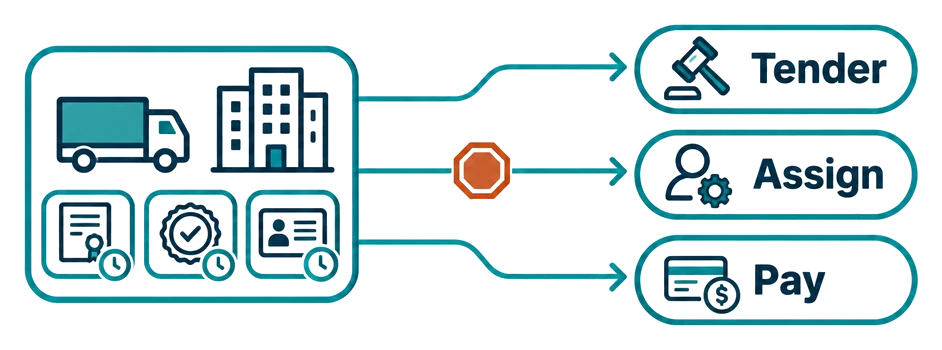


Checked, not filedInsurance certificates, operating authority and licenses are read against their expiry and the public registries every day, not once at onboarding.

Caught before the tender or the paymentA lapse changes what dispatch, the staffing desk and payables may do with that party the same day, with your approval.

Owned by a seatThe CLO and COO seats carry the exposure: who you are liable for, under which rule, and what it costs if it goes wrong.
What the lapse costs
Most states make a general contractor answerable for an uninsured subcontractor’s injured workers. A broker who tenders to a carrier with lapsed authority owns the claim.
of extra premium one contractor owed for subcontractors whose coverage had lapsed.
from an insurer’s cancellation notice to FMCSA revoking a carrier’s operating authority.
of freight brokers name unlawful brokerage as the top fraud tactic they face.
TIA, State of Fraud in the Industry, April 2025, as reported by FreightWaves
With Velenza a lapse is a change in the record, not a surprise in the audit.

Where today’s tools stop
Carrier-vetting services and certificate trackers check the document on their own screen. Dispatch, procurement and payables are other screens, so the lapse is known to the tracker and unknown to whoever tenders the load or pays the invoice. In Velenza the counterparty is one record; the tender and the payment know what the tracker knows.
The certificate was good in January. Velenza knows what it is today.
Velenza BOC
How a counterparty stays on the record.
Can we tender the Memphis load to Ridgeline Transport tonight?
VelenzaRidgeline’s cargo insurance was cancelled on 2 October per the insurer’s filing; the authority revocation runs on 4 November, and they are still in your carrier list. The COO seat advises against tendering; the CLO seat notes the claim would be yours. Two qualified carriers have capacity on the lane.
Why did the workers’ comp audit add $31,000?
VelenzaThree subcontractors worked after their certificates expired: 14, 22 and 31 weeks of payroll reclassified as yours, all paid by accounts payable in that period. The CFO seat recommends a certificate check at invoice approval; the CLO seat recommends a contract clause for next year.
Illustrative exchanges. The figures are examples.
In the room: CLO · Oliver Wendell Holmes Jr., COO · W. Edwards Deming, CFO · Luca Pacioli
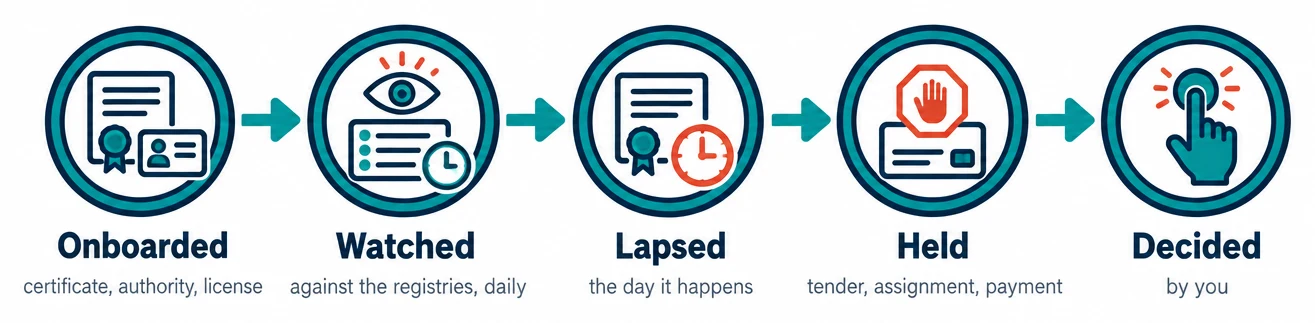

One counterparty, one record
LogisticsCarrier authority, insurance filings and safety status are read beside the tender and the payment, so a revoked carrier cannot be booked by accident.
ServicesSubcontractor certificates, professional licenses and worker credentials are read beside the assignment and the invoice, so the premium audit finds a record, not a folder.
Evidence for the auditorEvery check is on the record with its date, which is what the insurer, the examiner and the plaintiff’s lawyer ask for first.
The lapse, in dollars
A premium-audit reclassification$600,000 of subcontractor payroll at a $10 workers’ comp rate per $100 is about $60,000 of premium moved to you.
A claim with no insurer behind itThe average cargo theft loss was $273,990 in 2025 (CargoNet); on a lapsed carrier it is yours.
The injury claimA statutory-employer claim has no ceiling in this arithmetic; it is the reason the rule exists.
Industry and court figures; the payroll and rate are assumptions, and your exposure depends on whom you tender to and whom you pay. Worked examples and industry figures, never a measured result; your figures come from your record.
Where else it applies
Construction (statutory employer), healthcare practices (credentialing), any business that pays other businesses to do work it is liable for.
Where this case ends
This case is a legitimate counterparty whose coverage lapsed. Loss and fraud in the gaps is a counterparty who was never legitimate; audit on demand is proving your own controls, including this one, to an outsider.

Take back control of your business
Velenza sits above your existing platforms and connects their records and conversations. Keep what works; choose native capabilities on your terms.
Brandon Meyer | Founder/CEO, Velenza BOC Inc
brandon@velenzaboc.com | www.velenzaboc.com